
Anatomy for Artists Online Course
UPCOMING SESSIONS
STANDARD ENROLLMENT
Start now – REGISTER HERE
FULL ENROLLMENT (with Scott’s feedback)
AUTUMN: October 2, 2026 – REGISTER HERE
ABOUT
Welcome to Scott Eaton’s Anatomy for Artists online course page. The course is online to share the anatomy lessons of the old masters with artists intent on mastering the human figure. The course takes the daunting task of learning human anatomy and distills it into artist-focused lessons that cover the critical foundation that every figurative artist needs to know.
This course has been taught to artists from around the world including artists from leading animation, game, and visual effects studios – Industrial Light & Magic, Epic Games, Blizzard, Pixar, Ubisoft, Disney, Warner Bros, Sony, Valve and many others:

It has also helped build a solid anatomical foundation for students from art schools and academies including the the Florence Academy of Art, the School of Visual Arts (SVA), the Savannah College of Art and Design, Rhode Island School of Design (RISD), and the Art Students League of New York.
“I’ve been collecting anatomy books, DVDs and reference photos for over seven years. Scott’s course is by far the best resource I have encountered during these years, it is the best of the best. If you are serious about your anatomy knowledge you owe it to yourself to attend.”
Peter Levius
Artist
WEEKLY OUTLINE
The weekly lectures are broken down into the following topics. Click on the topic for a summary of the week’s lesson.
- Introduction, Proportions and the Skeleton
- Chest, Shoulders, Abdomen
- Upper and Lower Back
- Upper Arms and Forearms
- Pelvis, Upper and Lower Legs
- Hands, Feet, and Neck
- Gender, Age, Weight Variations
- Bonus Lecture: Introduction to Animal Anatomy
LECTURES
Each week students get access to self-paced video lectures covering the regions of the body outlined above (2-2.5 hours of lecture per week). In addition to the lecture material, each week Scott thoroughly reviews previous lectures and posts video replies to questions received about earlier lessons. Each lecture also sees Scott review the best (or worst) examples of “what not to do” by dissecting images in his infamous Gallery Abominate. This gives a humorous, but educational, look at common anatomical mistakes that beginners and professionals alike make in their work.
EXERCISES AND REVIEWS
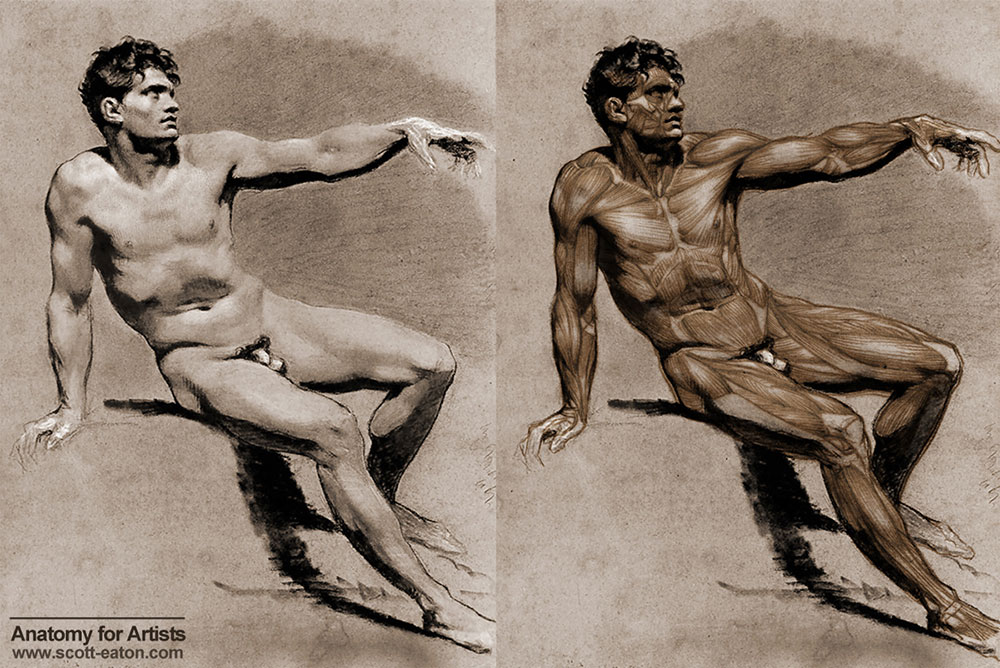
Lectures are great for presenting the material, but to really learn students must exercise the knowledge. So each week there are ecorche drawing assignments where artists visually dissect the work of Michelangelo, old master drawings, sculptures from the Louvre, and photographs from the Bodies in Motion library.
Exercises are reviewed the following week with a video showing Scott working through the same exercise, explaining the process and anatomy as he works.
Full-enrollment students are encouraged to submit their own work for review and critique (see more on enrollment options here). For the duration of the course, full-enrollment students have access to Scott’s time and knowledge and should take advantage by submitting personal work for review.
STUDENT RESOURCES
As part of the course, all students get six-months of full access to Scott’s Bodies in Motion reference library, the only resource of its kind on the web. The site contains near endless materials to study and deepen one’s understanding of human anatomy. The image sequence and 3D scans show the body as it is rarely seen – captured at high-resolution and in high speed sequences during complex, dynamic motion. The images allow artists to study the form and function of the body as across both simple and complex movements.
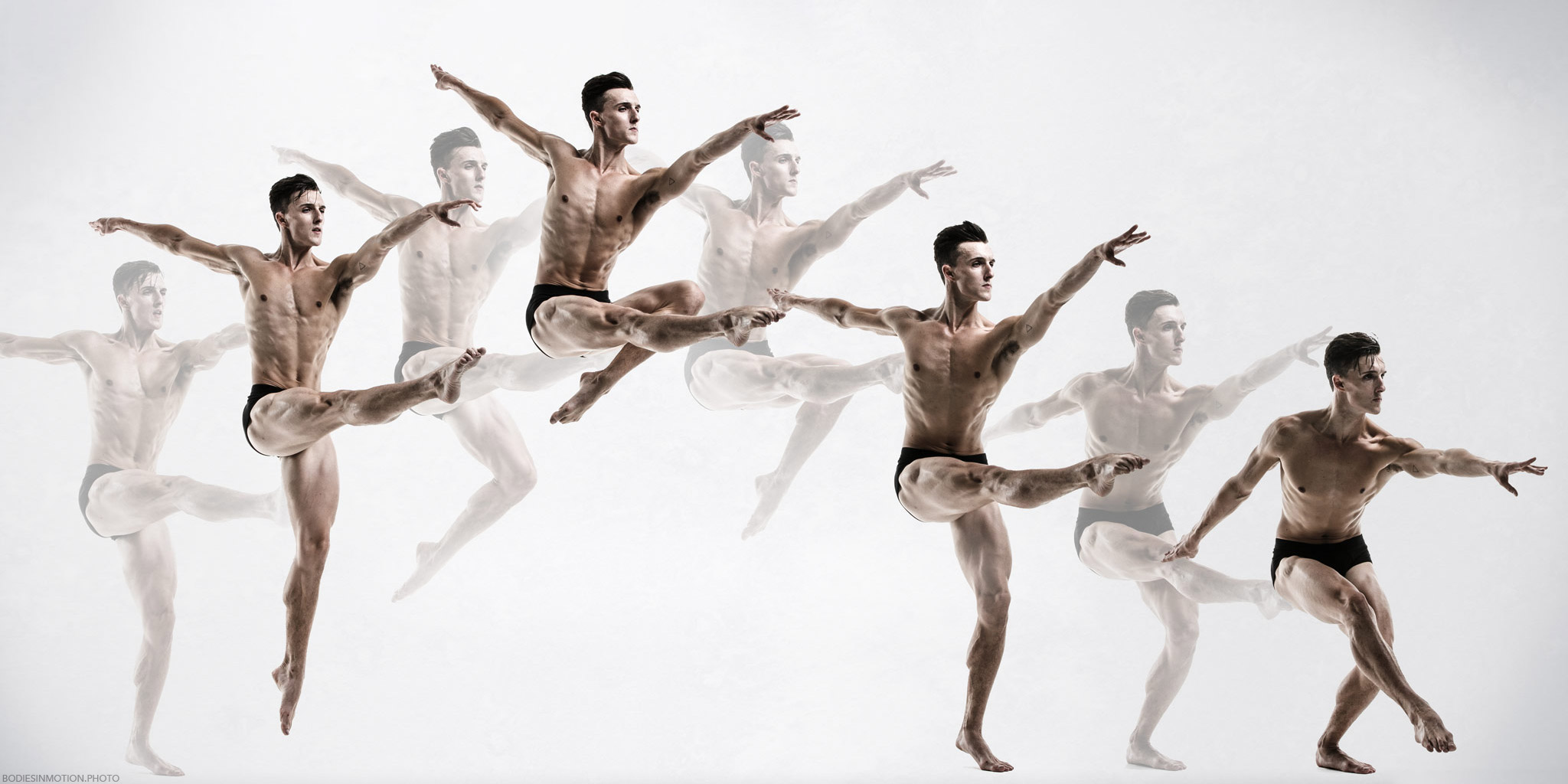 the Bodies in Motion reference library
RECENT FEEDBACK
“I will say that in 8 weeks of highly detailed and informative study through online video lecture I now feel I’ve had the proper training in anatomy I always wanted. The course is thorough and takes dedication but it’s worth every second of effort and every dollar of cost for a proper education on anatomy. I’d like to publicly thank Scott for such a comprehensive course.”
Peter Bragino
Fine Artist
New York
www.bragino.com
“I have been working in the games and visual effect industry for a long time now. Your Artistic Anatomy course showed me the true foundation of a human being. I realize now that all my anatomy books and anatomical figure didn’t help much before. But now even my book Anatomy Lessons from the Great Masters finally makes sense.”
Rudy Massar
Senior Modeller
Industrial Light & Magic
www.rudymassar.com
“I have been sculpting professionally for over 20 years and studying artistic anatomy for just as long. Scott’s vast knowledge and teaching style are by far the best I have ever experienced in all of my years of study. His method of ecorche drawings coupled with the investigative skills he teaches, make all my previous study stick for the first time. I tell all my colleagues and students that if you only take one anatomy course in your life, it must be with Scott Eaton!”
Michael Defeo
Character Development Artist
www.michaeldefeo.com
“I would have missed the study of the lifetime if I wouldn’t have joined this course. Thank you Scott for sharing your knowledge of anatomy and making a difficult subject easy for us to understand. Now I look at every figure, painting and sculpture with analytical eye and study it. I see myself as a better digital sculptor in coming years with this anatomy knowledge.”
Rishi Nandlaskar
Senior Modeler
Framestore
“I’ve been studying anatomy on and off for years, but the sheer amount of information out there and the often disjointed way of learning it left me with a bunch of gaping holes in my knowledge. I have to admit that during the 8 weeks of Scott’s course, I’ve learned and retained more solid information than all of my previous studies combined. Doing the assignments, in particular, made all the difference for me personally in actually making the information from the lessons stick. I’m not going to drag this out too long, but I just wanted to say that I absolutely loved the course and would wholeheartedly recommend it to anyone.”
Lars Ivar Stranden
Founder / Artist
Stranden Studio
PRESS
 click for larger image
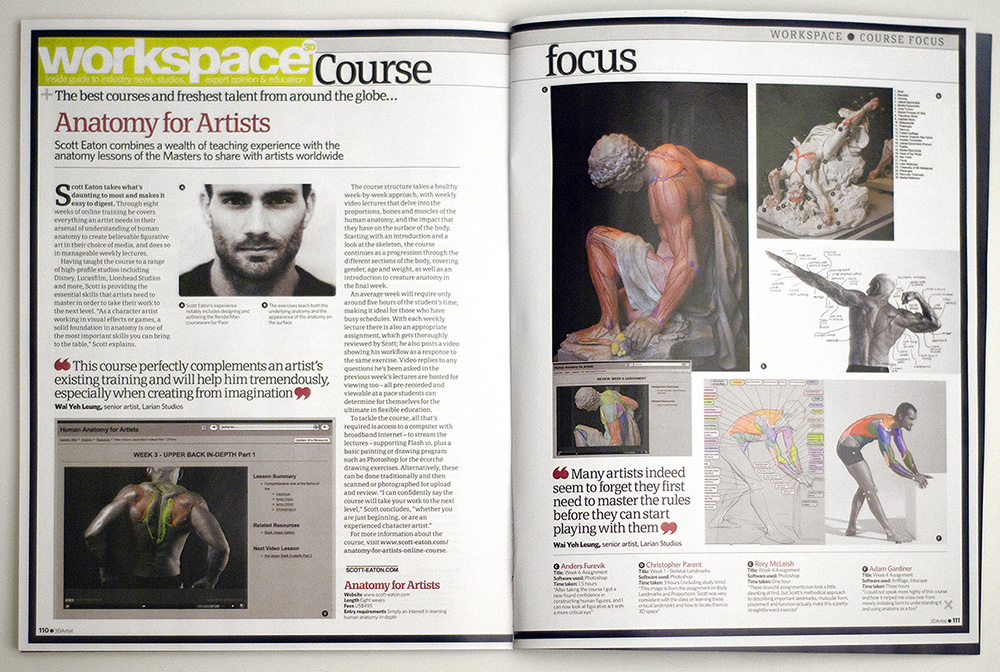
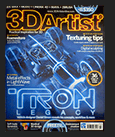 3DArtist magazine recently featured a two-page article on the Anatomy for Artists course. The writeup gives a good overview of the course and conveys the importance of studying anatomy for both figurative and digital artists. There are also some excellent examples of students’ work from past courses.
ENROLLMENT OPTIONS
This course has two levels of enrollment – standard and full.
Full enrollment: gives students complete access to all the course material as well as direct feedback from Scott on their assignments and other work they would like critiqued. Spaces are limited in order to maintain a high level of interaction with each student.
Standard enrollment: gives students access to same course material as full-enrollment students but without direct feedback. More information on enrollment options can be found here
COURSE SUMMARY
DURATION: 8 weeks + 4 months additional access (6 months total access)
COST: $895 Full Enrollment, $395 Standard enrollment
Materials/Resources Required
- Access to computer with broadband internet connection (for streaming lectures).
- Browser supporting HTML5, or any iOS enabled device (iPhone, iPad)
- A basic paint or drawing program (Photoshop, or free alternatives) for ecorche drawings. If done digitally a Wacom tablet is recommended. Alternatively these exercises can be done traditionally with pencil/paper and scanned or photographed.
QUESTIONS
How much time does the course require each week? Can I do it while working full-time?
A typical week requires four to five hours of your time. Roughly three hours for the lecture videos and the video reviews of the previous week’s assignment, and then another two hours to complete the new assignments. Many people have done the course while working full-time. It is designed to be flexible and accommodate people’s working schedules so the assignments are not mandatory, but they are strongly recommended and designed to reinforce the lectures.
My drawing skills aren’t great, can I still take the course?
Of course. The weekly assignments are ecorche exercises which consists of drawing over a set of images chosen to highlight the anatomy covered in the week’s lectures. The images range from Michelangelo drawings to some of the best images from the Bodies in Motion library. These exercises, which artists have been doing for hundreds of years, teach both the underlying anatomy and the appearance of the anatomy on the surface. Both of which are critical to a figurative artist. Since the ecorches are drawn directly over reference images, they exercises are suitable for a range of drawing skills from beginning to advanced. They are effectively knowledge and observation exercises.
I am a traditional artist, is the course suitable for me?
Yes, the course gives artists the critical anatomical foundation that they need to create great figurative art no matter what their medium. In the last year we have had wide range of artists on the course including character artists from visual effects and video games, comic book artists, concept artists, oil painters, stone carvers, medallion makers, figurine sculptors, photographers, fashion designers and even a chainsaw sculptor.
How do the video lectures work? are they streaming?
The video lectures are pre-recorded and streamed to HTML5 enabled browsers or iOS/Android devices. The course content is designed to be self-paced, and convenient for at home learning, no matter where you are in the world. Each week you will have access to new video lectures, which you will have a week to work through. Associated with each week’s lectures will be assignments due for upload the following week. They will be reviewed by Scott and a video solution posted showing Scott working through the same exercise. There will also be a weekly video question and answer session, where Scott answers people’s questions from the previous week’s lectures.
What if I am not happy with the course, can I get a refund?
Yes. Once the course starts you have two weeks to evaluate the content. At anytime in these first two weeks, if you are unhappy with the material or for some reason can’t continue with the course, a full refund will be issued.
How much do you cover on bones and the skeleton?
The entire first lecture is dedicated to proportions, bones, and the skeleton. In addition to this, given the fundamental importance of the skeleton to the mechanical function of the body, each weekly lecture talks about the bones in relation to origin and insertions of the muscles and how they influence the surface. If the bones directly or indirectly create surface form we talk about it.
Does online learning work?
The New York Times recently reported a study that online learning is actually more effective than classroom learning.
Scott has a wealth of experience teaching and building online learning materials. Most notably he designed and authored Pixar’s RenderMan Courseware. If it’s good enough for Pixar, we hope it is good enough for you!
Additional Questions?
If you have other questions related to the online anatomy course contact us here.
No Responses to “Anatomy for Artists Online Course”